
Snow Globe Economics
Let it snow, let it snow, let it snow...but not too much!

I agree with Timothée Parrique. We need to slow down. In my recent book Why We Struggle To Go Green I concluded with the following thoughts about a future that could be compatible with sustainable living:
“There is no scenario in which humanity “solves” climate change and then goes back to living as Americans do today. We will have to learn to live simpler lives—somewhere between a prehistoric existence and a twenty-first century Western middle-class lifestyle. Where exactly along that continuum we land depends crucially on the size of the stable global population. To date, the most likely scenario appears to be that everyone who cares at all about reducing carbon pollution will choose one or two core things to focus on: driving less; flying less; eating less meat. All of it together will not be enough, and that’s the hard truth.
…
Gradual depopulation from declining birthrates, coupled with the best achievable future technology, can enable humanity to achieve a long-term equilibrium energy budget at some livable rate of carbon emissions. Precisely which goods and services we consume will be different, of course. What seems inevitable is that the world will have to slow down tremendously: We will have much less mobility than we have become accustomed to over the past seventy-five years. Rampant consumerism will have to give way to an ethos of relative frugality that will challenge our social contracts. Whether we choose to make common cause with one another and construct an egalitarian and less wasteful world, or whether the many will be exploited by the few, is the same choice that we make every day.”
Need a copy? Visit Texas A&M University Press
Parrique compares the economy to a snow globe. Economic growth in his model can take one of two forms. We can either add more snowflakes (increase the number of measurable economic activities) or shake the globe more vigorously (conduct existing transactions more frequently). In either case, society consumes additional tangible (real) resources for the sole purpose of increasing the flow of intangible money. I’m looking forward to reading a brand new book from Nancy Folbre on this very topic.
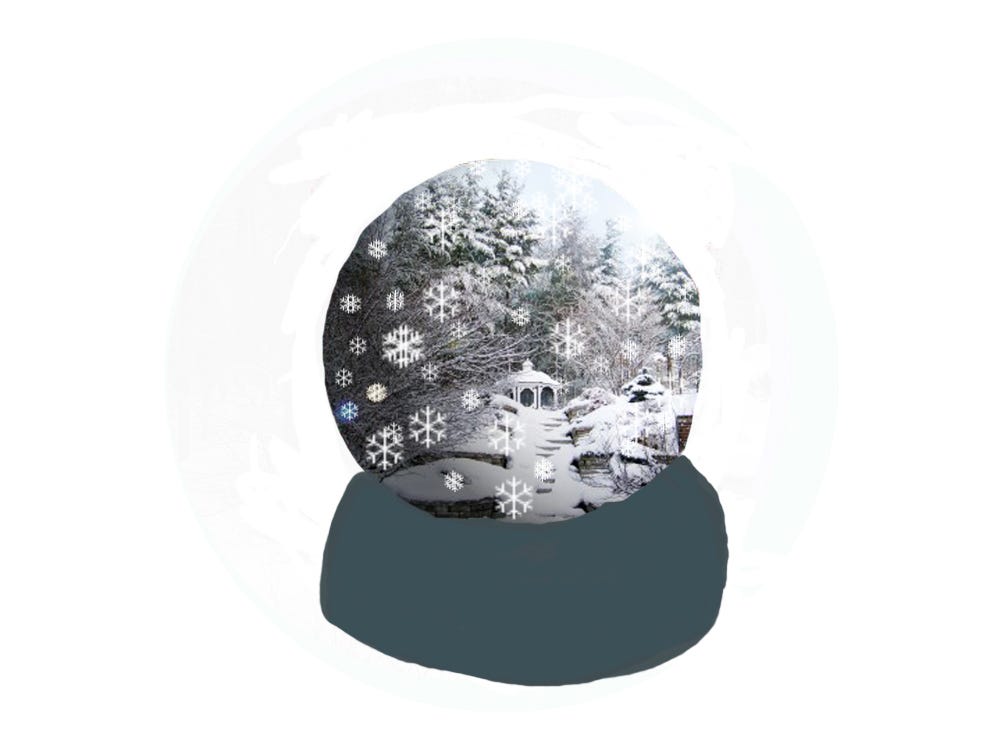
Source: Openverse
Slowing down, or degrowing, the economy has long been a goal of sustainability-minded thinkers. As an engineer, degrowth seems almost embarrassingly obvious as an approach to the problems of geopolitical rivalry, climate change, and inflation. Mechanical engineering is a pretty simple discipline at its core: conserve energy. Energy cannot be created or destroyed, only converted from one form to another. Mass, likewise, is conserved under all ordinary circumstances. (Small amounts of mass are converted to large amounts of energy in many nuclear reactions, but for most purposes of interest to us the quantity of mass at our disposal is fixed.) Chemistry is more or less the science of mass conversion from one form to another. Technology is nothing more than using energy conversions to achieve desirable mass conversions. Once you understand this, economic growth is evidently a self-limiting process. There is only so much usable energy available to transform our finite amount of usable mass. Our ability to harvest solar radiation or wind power does not change that fact at all.
Policymakers (and the billionaire class who control them) are well aware of all this, even if they do not, or cannot, express it in engineering terminology. Our system is set up to transfer almost all national income from production activities to a tiny elite. Yet subsistence demands require that a minimal amount of annual production instead be allocated to the rest of us. Mathematically, the only way to keep poor people alive and working while transferring increasing percentages of financial income to the rich is to expand the scope of the material economy. Money itself has no intrinsic value; it is merely a convenient proxy we use to make claims on the actual goods and services we want. So we mine raw materials and apply labor to transform them into consumer products—not only to keep people busy and distracted, but also to sustain the illusion of societal progress. Slowing down the economy naturally seems terrifying in such a system, because degrowth is perceived by many to be tantamount to impoverishment.
But many of the things we need most are not accounted for at all in the financial economy. Anything that cannot be readily priced in the marketplace or is considered to be unmarketable does not contribute in any way to gross domestic product (GDP). Environmental quality, human relationships, and peace of mind are examples. Other activities can exist on either side of the border isolating the official economy from what Parrique refers to as the anthropological economy (which surrounds it and includes non-market need satisfaction activities). If you care for your children at home, your labor is uneconomic in the sense that it does not contribute to GDP. If you hire a nanny, his/her wages do formally contribute to national income, even though the amount and quality of care given to the children may be identical in each case.
When we bring what was formerly a non-market activity into the market economy, we add snowflakes to Parrique’s globe. Where people used to have richer, more frequent interactions with friends and neighbors, they now spend more money on therapists. Where people used to have more time to cook and eat at home, they now use an app to order takeout and have it delivered. (Much of this lost time is spent commuting, which of course burns fuel that is becoming more expensive by the day as we wage insane wars.) On the other hand, when we accelerate the pace of existing market activities, we shake the snowflakes already in Parrique’s globe harder. As children, most of us (I’m talking to you, Generation X) shared the same corded home telephone for eighteen years. Now each family member buys a new mobile phone every two years. More money changes hands, but does it generate an equal amount of well-being? Sometimes the snowflakes are poisonous. Fish growing in the ocean lie outside the economic domain, and killing them with an oil spill costs nothing in terms of GDP. But spending money to clean up the oil spill? That’s economic growth (seriously!).
If we don’t need to buy as many material goods, we don’t need as much money. You can view the preceding statement as a call for austerity, but it needn’t be so dramatic. What if economic growth as measured by national income were to become negative because we had more free time to cook and care for children at home without hiring professional help? Ditto for lawn care, home repair, or any number of mundane tasks we might choose to do ourselves if we weren’t sitting in traffic or pointless meetings. Not everyone is a Bob Vila. I myself will still need to call for help with kitchen upgrades. Other people, though (my brother in law is an excellent example) would jump at the chance to hammer more frequently. It seems abundantly clear that many market activities which consume excess physical resources, from fuel and paid time to copper and steel, could be eliminated without diminishing true quality of life. The takeaway is that degrowth does not exclusively imply less satisfaction of our needs. It does, however, imply that the most wealthy among us will not be able to continue to make unlimited claims on the labor (free time) of everyone else on Earth forever.